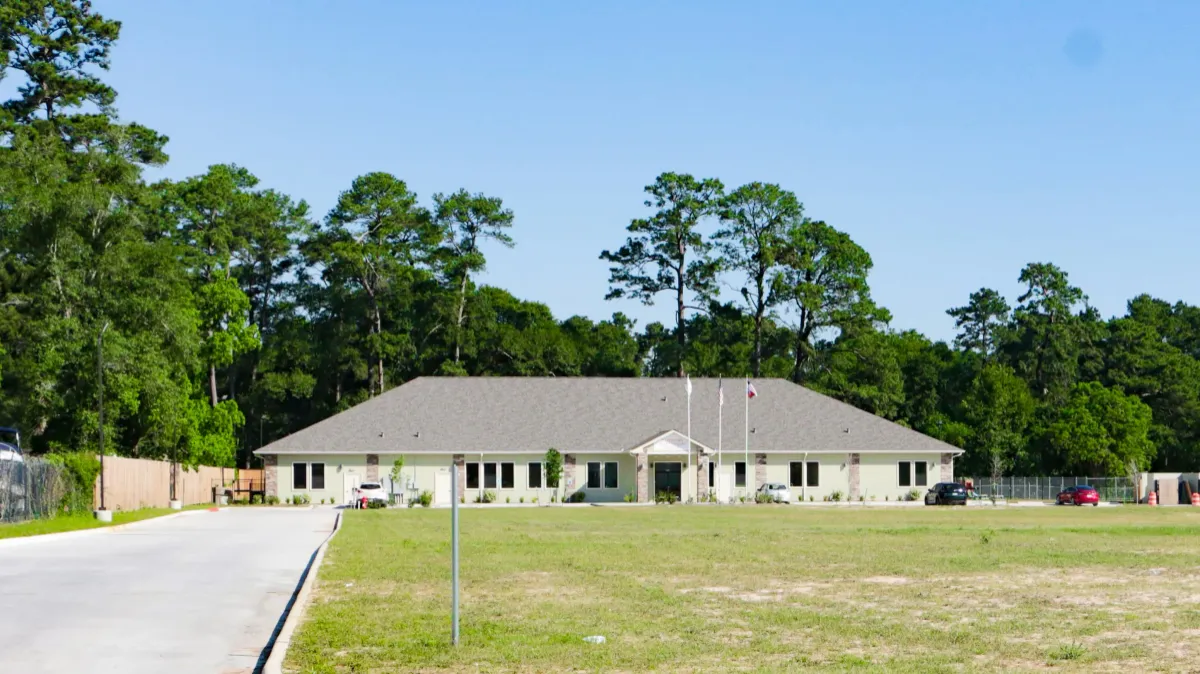
Preschool and Daycare in Spring, TX: How to Choose the Right Program in 2026
Preschool and Daycare in Spring, TX: How to Choose the Right Program in 2026
Every parent eventually faces the same question: do I need a preschool, a daycare, or both? The honest answer is that the best programs no longer make you choose. A quality preschool and daycare gives your child a safe place to spend the workday and a classroom that builds real skills in language, math, focus and independence.
This guide explains the difference between the two, what the latest research says about early learning, what to check on a school tour, and how costs and Texas childcare assistance work in 2026. It also shows how the programs at Blossoms Montessori School in Spring, Texas fit each stage from infancy to first grade.
Preschool vs. Daycare: What Is the Difference?
Traditionally, daycare meant supervised care while parents worked, and preschool meant a few hours of structured learning before kindergarten. Today the line has mostly disappeared. Parents need full-day coverage, and children benefit most when care and learning are built into the same day.
• Daycare focus: safety, routine, meals, rest and caring supervision, usually with long hours (often early morning to early evening).
• Preschool focus: a planned curriculum that builds early literacy, numeracy, social skills and school readiness, typically for ages 3 to 5.
• Combined model: a school that offers extended hours and a genuine learning program, so your child is cared for and taught from the moment of drop-off.
The combined model is the one most working families in Spring want, and it is how Blossoms operates: the school is open from 6:30 AM to 6:00 PM and every classroom follows an authentic Montessori approach.
What the Latest Research Says About Early Learning
Early childhood education has always had strong supporters, but one common criticism is that preschool gains tend to fade by first grade. A recent national study challenges that idea for Montessori. Researchers at the University of Virginia, working with the American Institutes for Research, followed nearly 600 children across 24 public Montessori programs in the first randomized controlled trial of its kind, published in the Proceedings of the National Academy of Sciences.
By the end of kindergarten, Montessori children outperformed peers in areas such as reading, short-term memory and executive function, and the advantage grew over time instead of shrinking. The study also found that three years of public Montessori preschool cost about $13,127 less per child than traditional programs. This is one study of public programs, and longer-term follow-up is still underway, but it is a meaningful sign that hands-on, child-led learning prepares children well for school.
Preschool and Daycare Programs by Age
Children change quickly in their first six years, so the right classroom at 12 months looks very different from the right one at five. Here is how the Blossoms programs map to each stage.
Infant Program (Ages 1 to 2)
A calm, nurturing space for young children taking their first steps toward independence. Learn more about the Infant Program.
Toddler Program (Ages 2 to 3)
Toddlers want to do things themselves. This program channels that drive into movement, language development, social growth and practical life activities such as pouring, dressing and tidying up. See the Toddler Program.
Primary Program (Ages 3 to 6)
The heart of Montessori preschool. Children use hands-on materials to build early reading, math and concentration, while learning to make choices and finish what they start. Explore the Primary Program.
Kindergarten and First Grade (Ages 5 to 7)
An advanced environment that bridges early childhood and elementary school, so children stay challenged and confident. View the Kindergarten and First Grade program.
After-School and Summer Programs
Kindergarten through fifth grade students can join the After School Program for homework help, reading, playground time, art and music. Children ages 3 to 12 can enjoy the Summer Program, which blends learning, creativity and outdoor play. You can see all options on the Programs page.
7 Things to Look for in a Preschool and Daycare
A bright website and a friendly front desk are not enough. Use this checklist on every tour:
1. Teacher qualifications and experience. Ask about Montessori certification (AMS or AMI), years of experience and staff turnover. Blossoms faculty hold certification from these respected organizations and average 10 to 15 years in early childhood.
2. Safety and background checks. Staff should be background-checked and fingerprinted, and trained in first aid and CPR.
3. Secure entry. Only authorized adults should be able to enter the building.
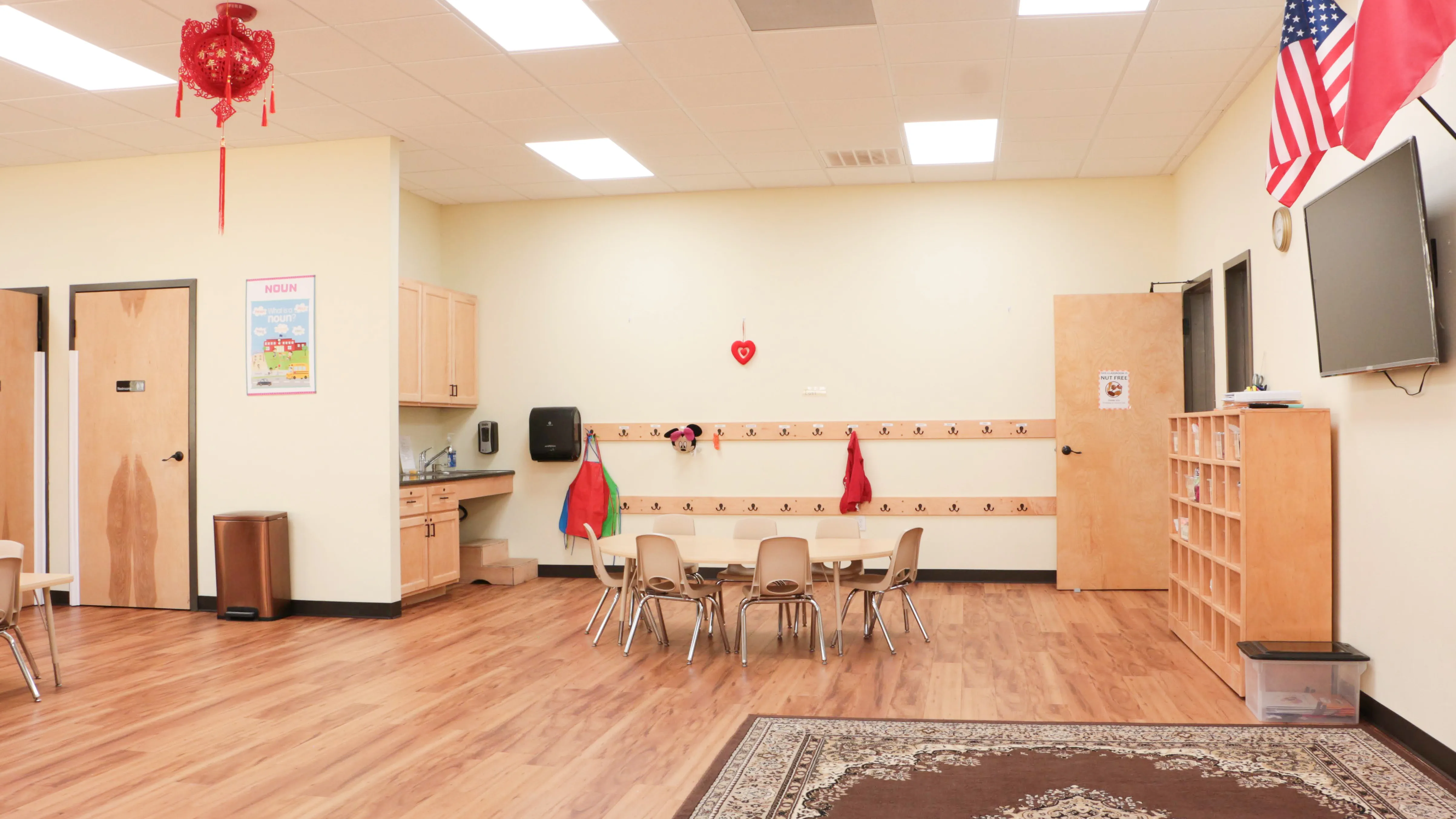
4. Classroom space and materials. Look for room to move, child-sized shelves and materials a child can reach and use independently.
5. Outdoor play. Daily time outside supports health, mood and sleep.
6. Communication. You should get regular updates, ideally photos and notes through an app, not just a chat at pickup.
7. Hours and flexibility. Make sure the schedule works with your commute and workday, including holidays and summer.
Safety and Security You Can See
Peace of mind is the real product in childcare. At Blossoms, the entrance is secured with unique pin codes so only authorized parents and approved individuals can enter, every staff member is background-checked and fingerprinted, and all teachers are First Aid and CPR certified. A parent communication app sends updates and photos through the day, so you are never guessing how your child is doing. You can read more on the unique benefits page.
A Campus Built for Learning and Play
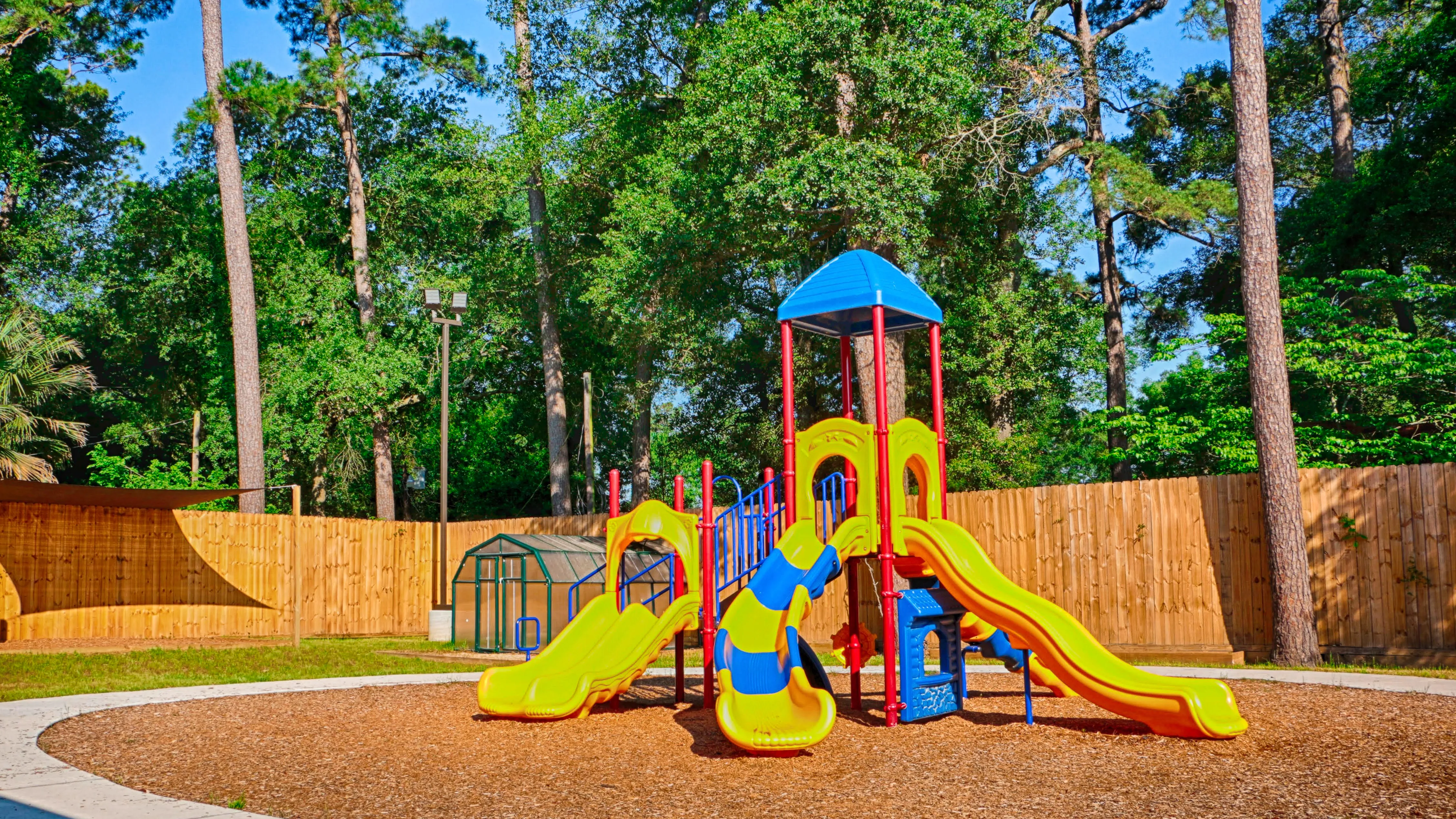
Space matters for young children. Spacious classrooms let children work on the floor, move freely and choose activities without crowding. Outside, the 20,000 square foot playground includes a greenhouse, raised garden beds and a bike track, so children can plant, water, ride and explore nature as part of a normal day. Gardening in particular is a natural extension of Montessori practical life skills: care for living things, patience and responsibility.
Costs, Assistance and Texas Childcare Updates for 2026
Tuition depends on the program and schedule, so the most reliable way to get accurate numbers is the pricing page. At the time of writing, the school website lists a registration fee discount, a tuition discount and a free gift for families who tour, but offers change, so confirm current details with the team.
If you are weighing financial help, it is worth knowing how the Texas system is shifting this year:
• Texas Child Care Services is run through the Texas Workforce Commission and local Workforce Solutions boards, and eligibility is based on income and work, school or training status. Families apply through the Texas Child Care Connection.
• In August 2026 the Texas Workforce Commission voted to cut about 9.5% of child care scholarship seats, roughly 14,000 seats, citing rising costs and tighter federal funding.
• Reporting this fall shows more than 190,000 Texas children on waiting lists for assistance, so applying early matters.
• TWC has also tightened attendance reporting and launched new resources for employers, including guidance on dependent care savings accounts and employer-supported childcare.
Ask your employer about a Dependent Care FSA, and visit the Parent Resources page or contact the school to learn what assistance options Blossoms works with.
What academic skills do Montessori preschoolers gain?
Montessori preschoolers in Spring, Texas develop foundational academic skills through hands-on materials and self-directed exploration. The Montessori Preschool Benefits in Spring extend across language, mathematics, science, and sensorial learning, all within a prepared environment that respects each child's natural developmental pace.
How does the Montessori approach build early reading and writing skills?
Children encounter language materials that isolate specific skills. Sandpaper letters teach phonetic sounds through touch and sight simultaneously. Moveable alphabets let children compose words before their hand is ready to write. This sequence builds confidence. It transforms abstract letter symbols into concrete, meaningful tools. A child who struggles with letter formation one week often writes independently the next, because the materials meet the child exactly where development stands.
What math concepts do children master before kindergarten?
Concrete materials make abstract number concepts tangible. Children count physical beads, arrange number rods by length, and manipulate golden bead materials representing units, tens, hundreds, and thousands. These experiences build a deep understanding of quantity, sequence, and place value. The Primary Program at Blossoms Montessori School supports academic, emotional, social, and practical life development through precisely these kinds of materials. Children work with Montessori materials in language, math, science, and more, gaining skills that transfer directly to later academic work.
The multi-age classroom structure amplifies these gains. Materials address the development of three, four, and five year olds within one community. Younger children observe older peers working with advanced concepts. Older children reinforce their own understanding by teaching younger classmates. This fluidity eliminates the pressure of arbitrary grade-level benchmarks while ensuring continuous progress.
Science and cultural studies round out the academic foundation. Children explore botany, zoology, geography, and physical science through puzzle maps, classification cards, and simple experiments. Hands-on experiences, guided independence, and meaningful classroom activities build confidence, focus, curiosity, and emotional growth. A child planting seeds in the school garden learns biology, patience, and responsibility in one integrated activity.
Parents in Spring who choose the Primary Program give their children an academic start rooted in understanding rather than memorization. The skills gained, reading with comprehension, computing with number sense, and investigating with scientific curiosity, serve children long after preschool ends.
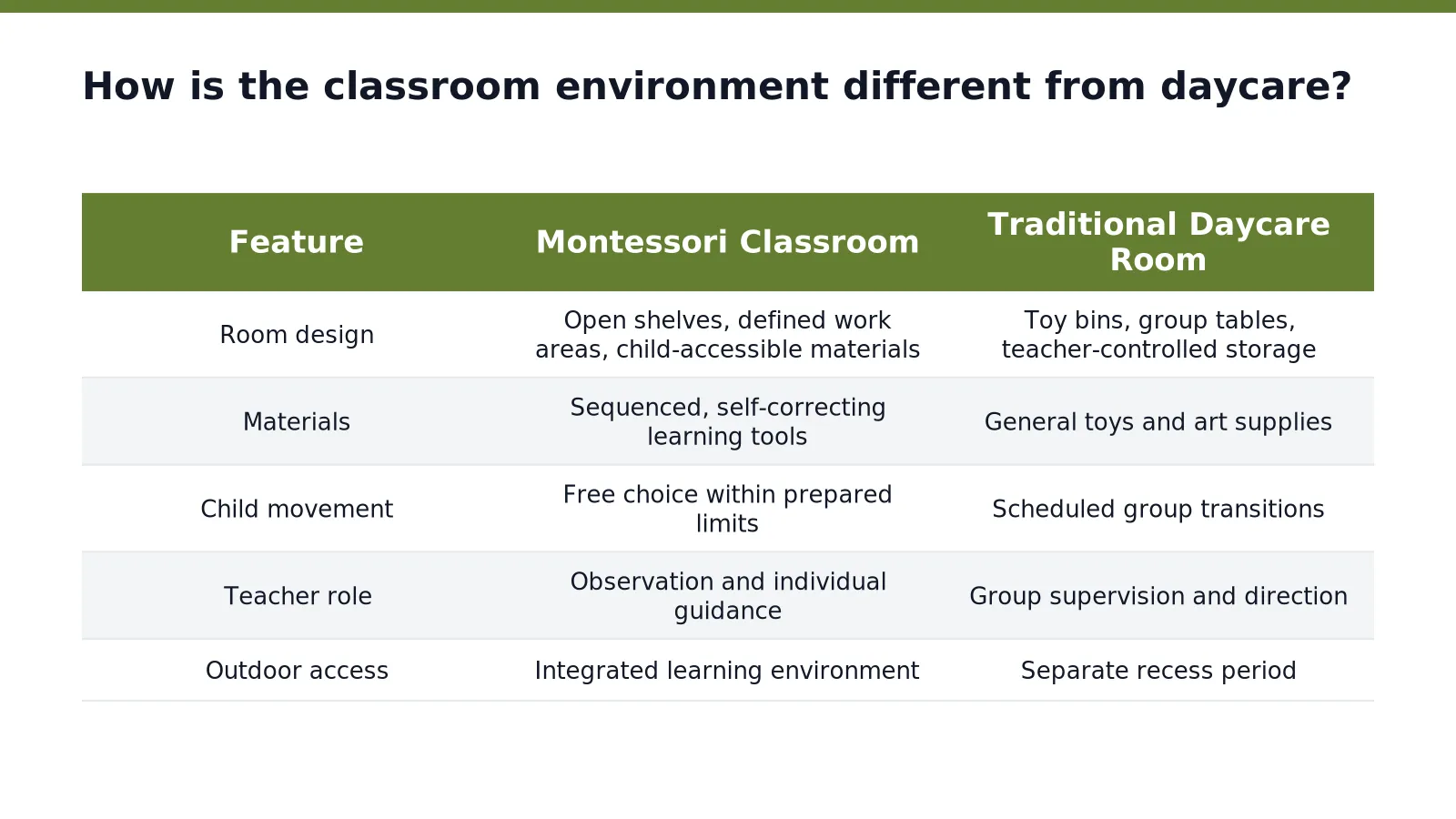
How is the classroom environment different from daycare?
A Montessori classroom functions as a prepared learning laboratory. A traditional daycare room operates as a supervised play space. The distinction shapes every object, routine, and interaction a child encounters throughout the day. Parents in Spring, Texas who tour both settings notice the difference within minutes.
What does a Montessori classroom look like compared to a daycare room?
Montessori environments feature open floor plans with low, accessible shelves holding sequenced learning materials. Daycare rooms typically arrange furniture for group management and contain toy bins for general play. Blossoms Montessori School occupies a state-of-the-art facility designed specifically for early childhood exploration and safety. The layout invites movement and choice. A daycare layout prioritizes containment and teacher-led transitions.
How does the outdoor space support learning?
The outdoor area extends the classroom rather than serving as a separate break zone. The school's massive playground includes a greenhouse, raised garden beds, and a bike track. Children have space to move, explore, garden, and connect with nature. Practical life skills transfer directly to the garden beds. Gross motor development happens on the bike track. A fenced daycare yard offers swings and slides but rarely integrates with the curriculum.
How to Enroll: A Simple 4-Step Process
1. Book a tour. Visit the campus, meet the teachers and see the classrooms in action. Schedule your visit here.
2. Review pricing and availability. Check tuition and enrollment information for your child's age group.
3. Complete the application. Submit the application form and required documents.
4. Attend orientation. Meet your child's guides and plan a smooth first week.
Why Families Choose Blossoms Montessori School
Parents choose Blossoms because it combines the flexibility of full-day daycare with the depth of authentic Montessori education: certified faculty, large classrooms, a secure campus, a big outdoor space and a clear path to elementary readiness. See what other families say on the reviews page, learn the story behind the school on the About page, or understand why Blossoms is different. For more parenting tips and early learning ideas, browse the Blossoms blog.
Ready to See It for Yourself?
The right preschool and daycare should feel right the moment you walk in. Book a tour at 3700 Louetta Road, Spring, TX 77388, call 832-220-1313, or email [email protected]. You can also get pricing before you visit.
Frequently Asked Questions (FAQs)
Q1. What is the difference between preschool and daycare?
Daycare focuses on safe, supervised care during working hours, while preschool focuses on structured early learning. A combined preschool and daycare, like Blossoms Montessori, offers both in one full-day program.
Q2. What ages does Blossoms Montessori School enroll?
Blossoms enrolls children from 11 months to 7 years, across the Infant, Toddler, Primary and Kindergarten and First Grade programs, with after-school care through fifth grade.
Q3. What are the school hours?
The school is open from 6:30 AM to 6:00 PM, which works for most full-time work schedules.
Q4. What makes Montessori different from traditional daycare?
Montessori classrooms are child-led and hands-on. Children choose purposeful activities, work at their own pace and build independence, while teachers act as guides. Learn more about the Montessori Method.
Q5. Is Montessori preschool worth it?
A 2026-published national randomized trial of public Montessori preschools found stronger kindergarten outcomes in reading, memory and executive function, with benefits that grew over time. Individual results vary, so a tour is the best way to judge fit for your child.
Q6. Is the school safe and secure?
Yes. The campus uses secure pin-code entry, staff are background-checked and fingerprinted, and teachers are First Aid and CPR certified.
Q7. Do you offer childcare assistance?
Families often ask about financial help. Because Texas assistance rules and funding are changing in 2026, check the Parent Resources page or contact the school for current options.
Q8. How do I enroll my child?
Start by booking a tour. After your visit, the team will walk you through the application, documents and orientation, and confirm availability for your child's age group.
Q9. Do you offer summer care and after-school care?
Yes. The After School Program serves K to 5th grade, and the Summer Program serves ages 3 to 12.
Conclusion
Choosing a Montessori preschool in Spring, Texas means selecting an environment where every detail, from credentialed teachers to integrated outdoor learning, builds a foundation for academic readiness and personal growth. A tour of the campus reveals this difference firsthand, allowing families to see the prepared classroom and secure their child’s place in a program that prioritizes understanding over memorization.


