Best Preschool & Daycare for Independence, Confidence and a Love of Learning
Best Preschool & Daycare for Independence, Confidence and a Love of Learning
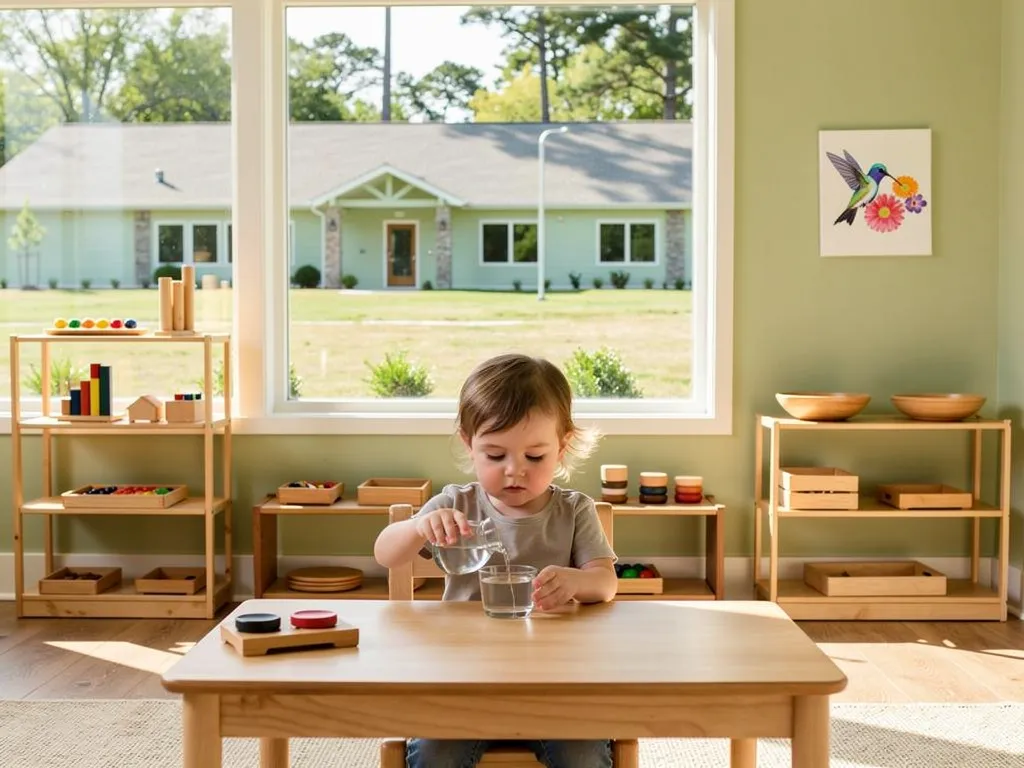
Walk into a well-run Montessori classroom and one of the first things you'll notice is what's not happening: no adult is hovering over every child, directing every move. Instead, you'll see three- and four-year-olds pouring their own snack, buttoning their own smock, and choosing their next activity from a shelf of options — all without being told to.
That's not chaos. It's the result of an environment deliberately designed to build independence from the ground up, a core part of the Montessori Method that sets the best preschool and daycare programs apart from typical childcare. For families comparing preschool, daycare, and childcare options, understanding this approach to early learning childhood education makes the difference clear.
What "Independence" Actually Means in the Best Preschool and Daycare Classrooms
Independence in Montessori education isn't about leaving children to figure everything out alone. It's about carefully preparing an environment — child-sized furniture, accessible materials, clear routines — so that children can do things for themselves once they're developmentally ready.
Dr. Maria Montessori's guiding principle was simple: don't do for a child what the child is capable of doing independently. When a task is broken into manageable steps and the environment supports it, even very young children can:
- Pour their own water and prepare a simple snack
- Put away materials after finishing an activity
- Choose their own work for the day
- Resolve small social conflicts with guidance rather than immediate adult intervention
- Complete multi-step tasks like getting dressed or washing hands unassisted
Why Independence Builds Confidence
Confidence doesn't come from being told "good job." It comes from a child discovering, through repeated first-hand experience, that they can do something difficult. Every time a child successfully completes a task on their own — even something as small as zipping a jacket — it reinforces a quiet internal message: "I am capable."
Montessori classrooms are structured to create dozens of these small wins every single day. Over time, they add up to a child who approaches new challenges with curiosity instead of hesitation.
From Confidence to a Love of Learning
Here's where the Montessori approach becomes especially powerful: because children are working on self-selected tasks at their own pace, learning starts to feel intrinsically rewarding rather than something imposed from outside.
A child who chooses to work with a set of counting beads because they're genuinely curious learns differently than a child who's told to complete a worksheet. The first child is building a relationship with learning itself — one that tends to last well beyond the Montessori years.
This is a key distinction from more conventional early education models, where extrinsic motivators (grades, stickers, teacher praise) often carry more weight than a child's own curiosity.
What This Looks Like for Toddlers in Quality Childcare
For toddlers, independence starts small — but it starts early. Our Toddler Program, a cornerstone of our childcare and early learning childhood education offerings, focuses on practical life skills: washing hands, putting on shoes, carrying a tray, cleaning up a spill. These aren't "chores." They're carefully chosen tasks that match a toddler's developmental drive toward independence, which peaks in exactly this age range, and which the best daycare and preschool programs are built to nurture.
Parents often notice this transfer home — toddlers who suddenly want to help set the table, pour their own milk, or dress themselves. That's not coincidence; it's the same independence-building philosophy at work, and it continues to build through our Primary Program for ages three to six.
A Note on "Freedom Within Limits"
It's worth being clear about something Montessori is often misunderstood on: independence doesn't mean unlimited freedom. Children choose from a curated, age-appropriate set of options, and clear boundaries remain in place around safety, respect, and care for materials. The "freedom" is real, but it exists within a thoughtfully designed structure — not instead of one.
Seeing Early Learning Childhood Education in Practice at Blossoms
Reading about independence and confidence is useful. Watching a three-year-old confidently choose, complete, and clean up their own activity — without being asked — is something else entirely.
At Blossoms Montessori School, one of the best preschool and daycare choices for families seeking genuine early learning childhood education, our classrooms are built around exactly this kind of prepared environment. If you'd like to see it in action, we invite you to book a tour and watch a typical Montessori morning unfold.
FAQ
At what age does Montessori start building independence? Independence-building begins in toddler programs (as early as 18 months in many Montessori settings) and continues throughout the primary years.
Does giving children this much choice lead to poor behavior? No — Montessori independence operates within clear, consistent limits. Choice is offered within a structured, curated environment, not as unlimited free rein.
How can I reinforce Montessori-style independence at home? Offer simple, achievable tasks matched to your child's current abilities (pouring, dressing, tidying) and resist the urge to complete tasks for them that they can do themselves. Our FAQ page covers more common questions from parents.


