Montessori for 1-Year-Olds | Infant Daycare in Spring, TX
Montessori for 1-Year-Olds | Infant Daycare in Spring, TX
Choosing childcare for a 1-year-old is one of the biggest decisions a parent makes. Your child is just learning to walk, babble and feed themselves, and you are trusting someone else with those milestones. If you have been searching for a daycare Spring Texas families recommend, you have probably noticed that most options sound alike: safe, caring, educational. The real differences show up in how the day is structured and how your child is treated as a learner.
This guide explains what Montessori looks like for a 1-year-old, how it compares with a typical daycare or preschool, and what to look for when you tour. It is written for parents who want childcare that does more than supervise, and who want to understand the method before they visit.
Why the Earliest Years Matter
Children between birth and age six absorb language, movement, routine and social behavior at a remarkable pace. Dr. Maria Montessori described the first six years as the most important period in a child's development, and modern early childhood research continues to emphasize how much happens in these years. A 1-year-old is not too young for a purposeful environment. This is when children begin to walk, say their first words, show strong preferences and insist on doing things themselves.
That last point is the heart of Montessori education for the youngest children. A 1-year-old who pushes away the spoon to feed themselves is not being difficult. They are showing the drive toward independence that a Montessori classroom is designed to support.
Daycare vs. Preschool vs. Montessori: What Is the Difference?
Parents often use these words interchangeably, but they describe different things:
- Daycare describes a service: care for your child while you work. Quality varies widely. Many daycare programs include learning activities, while others focus mainly on supervision and routine.
- Preschool describes an age stage: early education before kindergarten, usually for ages three to five. Preschools use many different teaching styles.
- Montessori describes an educational method. It can be used in infant, toddler and preschool classrooms, which means a Montessori school can serve as childcare and preschool at the same time.
That last point matters. You do not have to choose between childcare and a real learning environment. A Montessori program can offer full-day childcare hours and a clear educational philosophy together. Here is how the three typically compare:
These are generalizations, and programs of every type vary. The best way to judge any school is to visit it and watch a real morning.
What a Montessori Day Looks Like for a 1-Year-Old
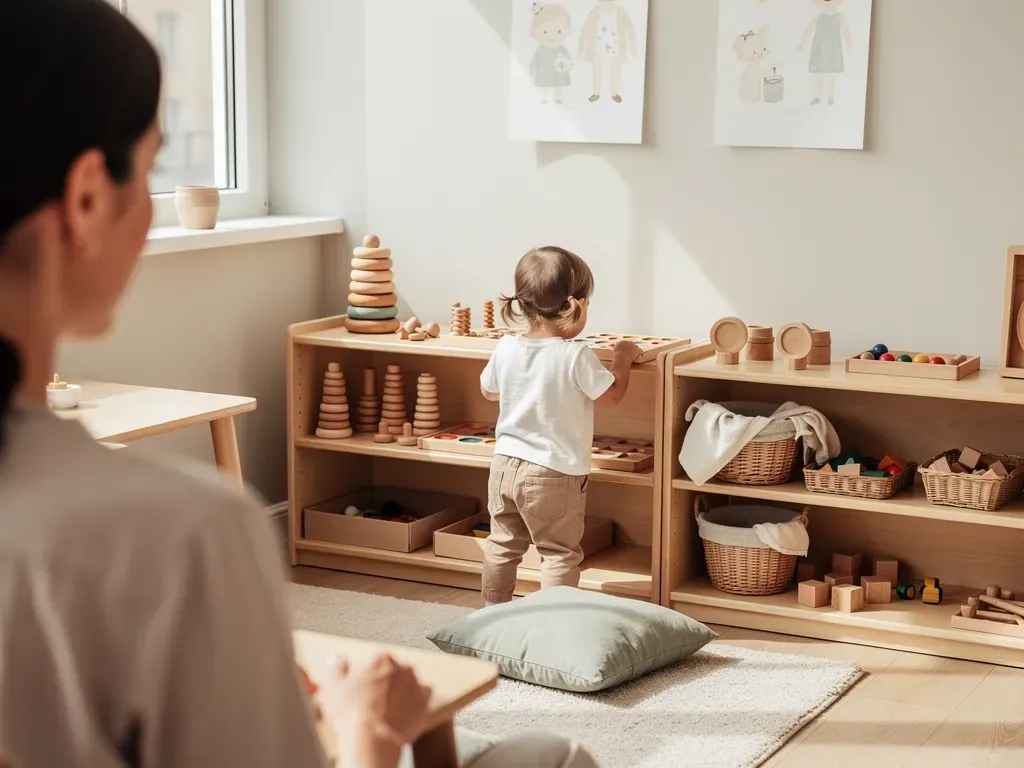
A Montessori classroom for one-year-olds looks different from what many parents picture. You will see low shelves, child-sized furniture, natural materials and plenty of open floor space. Here is what children actually do there.
Freedom to Move and Explore
One-year-olds are learning to crawl, pull up, walk and climb. Rather than keeping children contained for long stretches, Montessori environments give them room to move. Movement is how young children build strength, balance and coordination, and it supports their overall development.
Language All Day Long
Children this age understand far more words than they can say. Teachers speak to children respectfully and descriptively, naming objects, narrating routines and sharing simple books. Real vocabulary is used instead of baby talk, and children are encouraged to attempt words and gestures. This steady exposure builds the foundation for later reading and writing.
Early Practical Life
Practical life activities are the core of Montessori for toddlers. For a 1-year-old they are simple and real: drinking from a small open cup, helping wipe a table, putting a toy back on its shelf, washing hands at a child-height sink, or beginning to feed themselves. Each task builds coordination, concentration and a growing sense of "I can do it."
Care Routines as Learning Moments
Diapering, feeding and napping are not interruptions to learning in a Montessori program. They are part of it. Teachers slow down, talk to the child and invite participation, for example by letting a toddler help pull up their own pants or carry their own plate to the table. These small invitations teach cooperation and body awareness.
The Prepared Environment
Montessori educators call the classroom the "prepared environment." Everything is chosen and arranged with the child in mind: shelves at child height, a limited selection of materials so children are not overwhelmed, and a calm, orderly layout. Order matters to young children because it helps them predict what comes next and feel secure. When materials always live in the same place, a child learns to find, use and return them without adult help.
Compare that with a room crowded with toys, where choices are overwhelming and cleanup is an adult job. A thoughtfully prepared room teaches responsibility without a single lecture.
The Role of the Teacher
In Montessori the teacher is a guide rather than the center of every activity. For 1-year-olds, that means careful observation: noticing what a child is trying to master, offering a new material when they are ready, and stepping back when they are concentrating. At Blossoms, faculty come from respected Montessori organizations (AMS and AMI), and the school reports that its staff average 10 to 15 years of early childhood experience. Training and experience matter most with the youngest children, who cannot tell you what they need.
Safety, Communication and Peace of Mind
Parents of one-year-olds need confidence as much as curriculum. When comparing childcare options, ask about security and communication. Blossoms uses secure entry with unique pin codes, background-checked staff, and a parent app that provides daily updates, so you can stay connected during the workday. The campus is at 3700 Louetta Road in Spring and is open from 6:30 AM to 6:00 PM, which suits working families. You can see more on the Why Blossoms and unique benefits pages.
Is My 1-Year-Old Ready for Montessori?
There is no readiness test. Children do not need to be walking, talking or toilet trained to begin. Most children need a settling-in period, and separation feelings are normal at this age. Good programs help with gradual transitions, consistent caregivers and open communication. Over the first weeks, many parents notice their child becoming more interested in doing things for themselves at home, such as holding a cup or helping with a simple task.
Children also grow through the program. At Blossoms they move from the Infant Program (ages 1 to 2) to the Toddler Program (ages 2 to 3) and then to the Primary Program (ages 3 to 6). Staying within one philosophy gives children continuity as they grow.
Questions to Ask When Touring a Daycare in Spring, Texas
Whether you are comparing Montessori schools or traditional childcare centers, bring a short list of questions:
- Are teachers Montessori-trained, and through which organization?
- How much of the day do children spend moving and exploring freely?
- How are feeding, diapering and nap routines handled, and are children invited to take part?
- How will I hear about my child's day?
- What security measures are in place at drop-off and pick-up?
- How does the program support the move from infant to toddler to preschool?
Whatever you choose, visit in person. Seeing a classroom in action will tell you more than any website. If you are looking for a daycare Spring Texas parents can visit and compare, schedule more than one tour and notice how each room feels.
Infant and Toddler Programs at Blossoms Montessori School
Blossoms Montessori School offers a nurturing Montessori environment for children from 12 months to 6 years in Spring, Texas. Our Infant Program gives young children a calm space to take their first steps toward independence. The Toddler Program builds on that with hands-on learning, movement, language development, social growth and practical life activities.
Families who need childcare beyond the early years can also explore our Kindergarten & First Grade, After School and Summer programs. To learn more about how we teach, read about the Montessori Method, see our pricing, or visit the FAQ page.
Frequently Asked Questions
What age can a child start Montessori?
At Blossoms, children can begin as early as 12 months in the Infant Program. Montessori classrooms are designed for different stages, so there is an appropriate environment as your child grows.
Is Montessori daycare or preschool?
It can be both. Montessori is an educational method, not a type of childcare, so a Montessori school can provide full-day childcare while also offering early education.
How is Montessori different from regular daycare for a 1-year-old?
The biggest difference is the approach. Montessori uses a prepared environment, hands-on materials and an emphasis on independence, while many traditional daycare programs rely on a staff-led schedule and general toys. Quality varies in both, so visit before you decide.
Will my child adjust to a classroom setting this young?
Most children adjust well with consistent caregivers and a gradual transition. Talk with the school about how they handle drop-off and communication in the first weeks.
Does Blossoms offer tours?
Yes. You can book a tour online or call 832-220-1313.
See Montessori for Your 1-Year-Old in Spring, TX
Reading about Montessori is helpful, but watching toddlers work with focus and pride is what convinces most parents. Book a tour of Blossoms Montessori School, check our pricing, or contact us with questions. We would love to show you what a Montessori day looks like for your child.


