Kindergarten Readiness Checklist: Is Your Child Ready?
Kindergarten Readiness Checklist: Is Your Child Ready?
Every year, parents across Spring, Texas ask the same question: is my child ready for kindergarten? Whether your child is in daycare, preschool or a Montessori classroom, it is natural to wonder about letters, counting and sitting still. The answer is more nuanced than a letters-and-numbers test. Kindergarten teachers look for children who can manage themselves, get along with others and approach learning with curiosity.
This kindergarten readiness checklist covers the skills that matter most, explains how a Montessori preschool builds each one, and offers practical ideas you can use at home. Treat it as a guide for conversation, not a grade.
What Does "Kindergarten Ready" Really Mean?
In Texas, public school districts generally require children to be five years old by September 1 to enroll in kindergarten, but cutoffs and requirements can vary, so confirm the details with your school district. Age eligibility is only part of the picture. Readiness reflects emotional maturity, independence, language and early academic skills working together.
Children also develop at different rates. A child who is a confident talker may still be learning to separate from parents, while a child who is shy may already be counting past twenty. A single skill rarely tells the whole story, which is why looking at the full range of abilities is more useful than focusing on one.
Kindergarten Readiness Checklist
Use the lists below to notice strengths and areas to practice. Your child does not need to master every item before starting school.
1. Independence and Self-Care
- Uses the toilet independently and washes hands
- Puts on and takes off a jacket, with help for tricky zippers or buttons
- Opens lunch containers and feeds themselves
- Carries, unpacks and puts away their own belongings
- Tries a task before asking for help
2. Focus and Following Directions
- Stays with one activity for several minutes at a time
- Follows two- or three-step directions
- Listens to a story read aloud from beginning to end
- Moves between activities without major distress
- Finishes what they start and helps clean up
3. Social and Emotional Skills
- Takes turns and shares with gentle guidance
- Uses words to express feelings and needs
- Separates from parents with reasonable comfort
- Shows kindness and respect for classmates
- Works through small conflicts with adult support
4. Language and Early Literacy
- Speaks in full sentences and shares ideas
- Recognizes many letters and some letter sounds, especially in their own name
- Enjoys books and can retell a simple story
- Holds a pencil or crayon and draws shapes and lines
- Notices rhymes and beginning sounds
5. Early Math and Thinking
- Counts objects and connects numbers to quantities
- Recognizes basic shapes and colors
- Sorts items and notices simple patterns
- Understands ideas like more, less and the same
- Asks questions and wants to know how things work
Notice that three of the five categories have little to do with academics. Letters and numbers matter, but they grow best on a foundation of independence, focus and social skills. A child who can listen, persist and ask for help is well prepared to learn almost anything.
How Montessori Builds Kindergarten Readiness
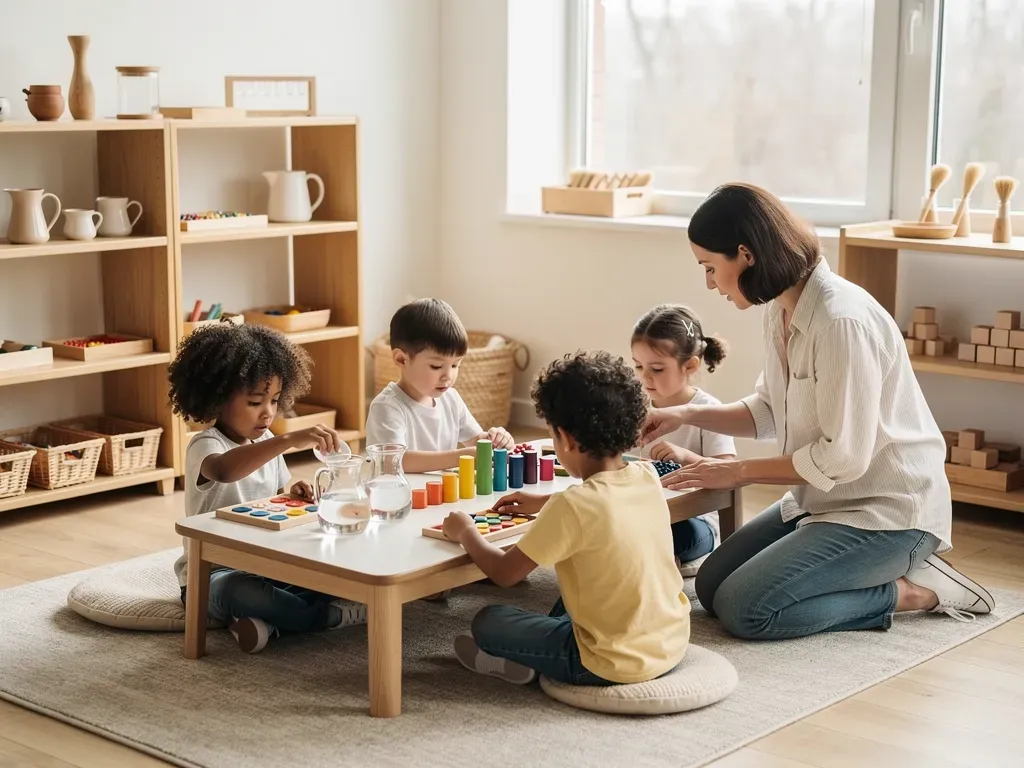
A Montessori classroom is designed around the same skills on this checklist, which is why many families choose it as preparation for school.
Independence Is the Daily Curriculum
Practical life activities such as pouring, buttoning, preparing snacks and caring for the classroom build the self-care skills in category one. Children do these tasks themselves, every day, until they become routine. By age five, many Montessori children can manage their own belongings, clean up after themselves and solve small problems without waiting for an adult.
Concentration Through Uninterrupted Work
Montessori classrooms schedule long work periods in which children choose an activity and stay with it. This repeated practice builds the focus and persistence kindergarten teachers value. Children learn to finish a task, return materials to the shelf and begin something new, which mirrors the rhythm of a school day.
Hands-On Literacy and Math
Instead of memorizing abstract symbols, Montessori children work with concrete materials such as sandpaper letters, a moveable alphabet and counting beads. They feel the shape of a letter, build words sound by sound, and see what a quantity looks like before moving to numerals. This approach helps children understand concepts rather than simply repeat them.
Social Skills in Mixed-Age Classrooms
In a Montessori primary classroom, children ages three to six learn together. Younger children watch and learn from older classmates, and in their final year, older children often become the leaders who help others. Serving as a role model builds confidence and communication skills right before the transition to elementary school.
Daycare vs. Preschool vs. Montessori: Which Prepares Children Best?
Parents often compare these three options, so it helps to define them clearly. Daycare is childcare for working families, and many programs include learning activities. Preschool is early education before kindergarten, usually built around teacher-led lessons, songs, crafts and group play. Montessori is an educational method that can be used in either setting, so a Montessori school can provide childcare and preschool together.
Any of the three can prepare a child well, depending on the quality of the program. What matters most is the daily experience: how much time children spend practicing real skills, working independently and building relationships with caring adults. When touring a daycare Spring Texas parents are considering, ask what a typical morning looks like for four- and five-year-olds and how teachers prepare them for kindergarten.
The Kindergarten Years at Blossoms Montessori School
At Blossoms, children ages three to six learn in our Primary Program, which builds independence, early academics, confidence and elementary readiness. Children ages five to seven can enroll in our Kindergarten & First Grade program, an advanced Montessori environment that bridges early childhood and elementary education.
Working families can also use our After School Program for kindergarten through fifth grade, which includes homework help, reading, playground time, art and music, and our Summer Program for ages three to twelve. Our campus offers secure entry, background-checked staff, a parent app for daily updates and a 20,000 square foot playground with a greenhouse, garden beds and bike track. Learn more on our Why Blossoms page.
How to Support Kindergarten Readiness at Home
- Let your child do it: Allow extra time for dressing, pouring a drink and packing a bag.
- Read together daily: Ask questions about the story and let your child predict what happens next.
- Count real things: Stairs, snacks and socks make math meaningful.
- Give small responsibilities: Setting the table or feeding a pet builds confidence.
- Keep routines steady: Consistent sleep and morning habits make school mornings easier.
- Talk positively about school: Visit the building, meet the teacher and share your own good school memories.
When to Seek Extra Guidance
If you are concerned about your child's speech, hearing, vision, attention or overall development, talk with their teacher and your pediatrician. Early support can make a real difference, and asking questions is never a sign of failure. A good preschool will share what it observes and work with you as a partner.
Choosing a Preschool in Spring, TX for Kindergarten Readiness
When you compare preschool and childcare options, look beyond the name on the sign. Consider asking:
- How does the program build independence and self-care skills?
- How long can children work on one activity without interruption?
- How are early reading and math taught?
- How are children supported socially and emotionally?
- How will I know my child is progressing toward kindergarten?
The answers will show you whether a program is preparing children for the whole experience of school or only for a test. Visit in person, watch the children and trust what you see.
Frequently Asked Questions
Is my child ready for kindergarten if they cannot read yet?
Yes. Most children are not reading independently before kindergarten. Recognizing some letters, enjoying books and speaking clearly are good signs, but independence, focus and social skills are just as important.
What age should a child start kindergarten in Texas?
Texas public schools generally require children to be five by September 1, though policies can vary by district. Check with your local school district for current rules.
How does Montessori prepare children for a traditional school?
Montessori builds independence, concentration, social skills and early academics that transfer to any classroom. Some children need a short adjustment period when the structure changes, which is normal.
Does Blossoms offer programs beyond preschool?
Yes. Blossoms offers Kindergarten & First Grade, an After School Program for grades K through 5, and a Summer Program. Visit our FAQ page for more answers.
See How Blossoms Prepares Children for Kindergarten
The best way to understand Montessori readiness is to see it. Book a tour of Blossoms Montessori School in Spring, TX, review our pricing, or contact our team with questions. We would be happy to help you decide whether your child is ready for the next step.


